
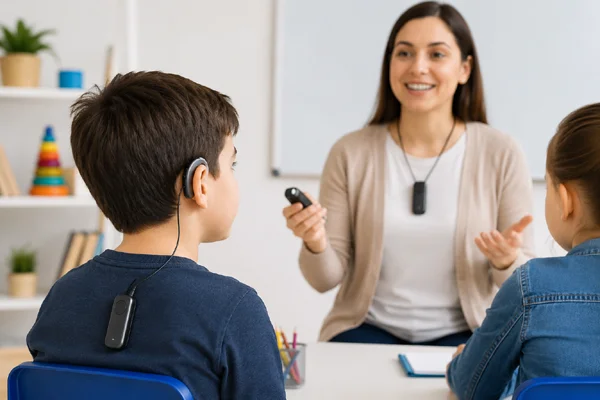
Listening and understanding speech can be challenging for some children, particularly in noisy classrooms, group conversations, or environments where several people are speaking at once. Children diagnosed with Auditory Processing Disorder (APD), Autism Spectrum Disorder (ASD), and other developmental or communication-related conditions may benefit from additional listening support when recommended by an appropriate professional.
At Blooming Minds in Singapore, we understand that every child's communication and learning needs are different. Roger System recommendations for children with APD, ASD and other disorders can form part of an individualized approach to helping children access spoken information more effectively in everyday environments.
A Roger system is a remote microphone technology that can transmit a speaker's voice directly to a compatible hearing device or receiver. This type of technology may be particularly useful in situations where background noise, distance, or room acoustics make listening more difficult.
The goal is not simply to introduce technology, but to identify whether it is appropriate for the child's specific listening needs and how it can best support participation at home, school, and other environments.
A Roger system is a wireless remote microphone solution designed to help improve access to speech, particularly when there is background noise or distance between the speaker and listener.
A microphone worn or used by the speaker captures their voice and transmits it to a compatible receiving device used by the child. This can help make the speaker's voice more accessible in challenging listening situations.
For children, Roger technology may be considered when listening difficulties affect classroom participation, following instructions, communication, or learning.
However, suitability varies from child to child. A professional assessment of the child's hearing, listening, communication, and educational needs is important before recommending a particular assistive listening solution.
Roger technology may be considered for children who experience difficulty understanding speech, particularly in noisy or complex listening environments.
This may include children diagnosed with:
A diagnosis alone does not automatically mean that a child needs a Roger system. Recommendations should be based on the child's individual functional needs and professional assessment.
A child may appear to hear sounds normally but still experience difficulty understanding spoken information in certain environments.
For example, classroom situations may involve:
These factors can make listening more demanding.
For children with APD, the challenge may involve processing and interpreting auditory information. For some children with ASD or other developmental conditions, sensory, attention, communication, or environmental factors may also affect how they access spoken information.
Children with Auditory Processing Disorder may experience difficulties understanding speech when there is competing noise or when information is presented rapidly.
A remote microphone system may be considered as one possible support strategy because it can provide a clearer signal from the primary speaker.
Potential situations where such technology may be considered include:
The exact recommendation should be based on an individual assessment rather than the diagnosis alone.
Children with Autism Spectrum Disorder can have diverse communication, sensory, attention, and listening profiles.
Some children may find noisy environments overwhelming or may have difficulty focusing on a particular speaker when several sounds are present.
For a child who has difficulty accessing spoken communication in noisy environments, a remote microphone system may be explored as part of a broader support plan.
The technology should be introduced carefully and in a way that considers the child's sensory preferences, comfort, communication style, and everyday routines.
The classroom is one of the most important environments to consider when evaluating a child's listening needs.
A teacher may be several metres away from a child, while other students are talking or moving around. Even when a child can hear sounds, understanding the teacher's speech may become more difficult.
A remote microphone system can potentially help by bringing the speaker's voice more directly to the child's compatible receiving technology.
Depending on the child's needs and school environment, it may be considered for:
Helping the child access spoken instructions from the teacher.
Supporting listening when several students are participating.
Helping the child focus on the primary speaker during structured activities.
Providing additional listening support when background noise makes speech harder to understand.
Supporting access to a speaker's voice when the speaker is farther away.
At Blooming Minds, technology recommendations should be based on the child's individual profile rather than a standard device recommendation.
We begin by understanding the child's communication, developmental, learning, sensory, and listening needs.
Parents and educators can share observations about situations where the child experiences difficulty understanding speech.
These may include classrooms, group activities, outdoor environments, or conversations in noisy settings.
Existing hearing, auditory processing, developmental, educational, or communication assessment information may help provide a broader understanding of the child's needs.
If additional listening support is appropriate, suitable assistive technology options can be considered based on the child's needs and environment.
Where appropriate, trialling technology can help determine whether the child responds positively and whether it provides meaningful functional benefits.
The selected system and compatible equipment should be appropriately configured according to professional recommendations and the child's needs.
Parents and teachers may need guidance on using the system consistently and appropriately in everyday environments.
The child's experience and functional needs can be reviewed over time. As children grow and their learning environments change, technology requirements may also change.
Remote microphone technology may help make a primary speaker's voice more accessible in challenging listening environments.
It can be considered as one strategy for helping children access teacher-led instruction.
Providing a clearer speech signal may reduce some of the challenges associated with distance and background noise.
Better access to spoken information may support participation in learning and group activities when the technology is appropriate for the child.
Recommendations can be based on the child's specific listening profile rather than simply their diagnosis.
Technology is only one part of supporting a child's listening and learning needs.
Depending on the child's profile, other strategies may include:
A combination of strategies may sometimes be more effective than relying on one solution alone.
Blooming Minds is an Early Intervention & Learning Support Centre in Singapore focused on individualized support for children and families.
Our approach is based on understanding the individual child and identifying practical ways to support their development, communication, learning, and independence.
We consider the child's individual strengths, needs, preferences, and developmental profile.
Assistive technology should be selected according to the child's functional requirements rather than simply their diagnosis.
Parents and caregivers are an important part of understanding how a child responds to technology across different environments.
Where appropriate, listening and communication strategies can be considered in relation to the child's classroom experience.
Children's needs can change as they develop and move into new learning environments. Regular review can help ensure that support remains relevant.
A Roger system is a wireless remote microphone technology designed to help transmit a speaker's voice more directly to a compatible receiving device, particularly in challenging listening environments.
A Roger system may be considered for some children with APD when listening difficulties affect communication or classroom participation. Suitability should be determined through appropriate professional assessment.
Some children with ASD may benefit from additional listening support, particularly when background noise or distance makes speech difficult to access. However, individual needs vary.
No. Remote microphone technology may be considered in different situations where a child has difficulty accessing spoken information. Professional assessment is important to determine whether it is appropriate.
It may help children access a teacher's voice in situations where distance or background noise makes listening difficult. Its suitability depends on the child's needs and school environment.
No. A diagnosis does not automatically mean that a Roger system is required. Recommendations should be individualized and based on functional listening needs.
Selection can take into account the child's listening profile, hearing technology if applicable, communication needs, school environment, age, comfort, and everyday activities.
Yes. A child's communication and educational needs can change over time, so assistive technology should be reviewed when necessary.
For children with APD, ASD, and other disorders, accessing spoken information can sometimes be challenging, particularly in noisy or demanding environments. Roger System recommendations for children with APD, ASD and other disorders can provide one possible avenue of assistive listening support when appropriately assessed and fitted.
At Blooming Minds in Singapore, we take an individualized, child-centred approach to assistive technology. By understanding each child's unique listening, communication, developmental, and educational needs, families can make more informed decisions about technology and other supportive strategies.
The ultimate goal is to help children listen, communicate, learn, participate, and develop greater confidence and independence in everyday life.